Christmas Message 2025/2026 from His Eminence Metropolitan Jean of Dubna
To their Excellencies, and to the clergy, the monks, the nuns and the faithful of the Archdiocese of the Orthodox Churches of the Russian Tradition in Western Europe
CHRIST IS BORN, GLORIFY HIM!
Who is Jesus Christ to you?
For some time now, numerous publications, relayed by the media, have been insidiously suggesting, under the guise of science or psychoanalysis, that Christianity is an infantile, even archaic, religion, whose purely mythological beliefs rest on outdated dogmas that once catered to the all-too-human thirst for the irrational. According to various authors, all of this has lost its credibility and has no future. Christianity is also presented as just another religion whose destiny will end in a vaguely transcendent humanism and globalized respect for humanity—a project widely advocated by the prevailing, but now exhausted, universal humanism.
For Christians, this is the true challenge of the future. Christ himself asks the central question of our faith, just as He did it to his disciples: “But who do you say that I am?”
Who is this Jesus whose birth we will soon celebrate?
Is He merely a man, just a man who performed a few miracles and whose teachings place Him among the great religious geniuses? For many today, Jesus is only that. Is He, thanks to His religious genius, the initiator of a universal morality enshrined in the Human Rights and which universal humanism attempts to proclaim throughout the world, a morality that attracts and seduces, without reference to the One who spoke in the name of Another? Today, attempts are being made to make Christians believe this.
Is He, Jesus Christ, the Revelation of God in human history, the eternal Son of a creating and loving God? Is He God himself, the second Person of the Holy Trinity? Generations of children, women, and men have confessed this, sometimes at the cost of their lives, because they answered the question, Jesus asked them. For humanists today, this is madness. Saint Paul reminds us that for those of yesterday, this too was folly. We can confidently say that for those of tomorrow, it will also be folly…
For two thousand years, the question of Jesus has not been fully answered; it has always provoked the same controversy, the same attacks against the faith of the Church. From the first Christian preaching, through the great Christological councils, the Age of Reformation and the Enlightenment, to the present day, the questioning of Christ’s divinity and the diatribes against Christians have not varied much.
Our faith, expressed in the Creed that we proclaim at every Liturgy, is identical to the faith of the Apostles and the first disciples of Jesus and to the written Word of the New Testament. This faith is based on the Person and the Word of Jesus Christ. His Person and His Word are the source of the faith and communion of Christians. The Church is where this Person lives and where the Church can experience the enduring nature of His Word. The first witnesses to the work of Jesus was the Church, that is, the disciples confessing the reality of the Person of Jesus. The community formed around Christ, proclaiming the Good News of the Gospel of God, affirmed for all to see that the existence and message of Christ are a historical reality. One cannot separate the Jesus of faith from the Jesus of history, as some contemporary exegetes do. No one, neither among Jews nor Gentiles, doubted the reality of the life and death of Christ. Only a few modern “historians,” more eager for sensationalism than for history, have put forward “the myth of Jesus.” It is evident today that Jesus truly existed and that he is an integral part of our history.
The Incarnation, the Salvation proclaimed by Christ the Son, the Resurrection which gives meaning to death, the Love of God the Father for His creation, the strengthening presence of the Holy Spirit, the Church as a place of mercy and forgiveness for humanity wounded by sin—all of this is part of the story of Jesus Christ, just as He Himself is part of the history of mankind and gives meaning to History.
If Jesus, the Christ, is not God, there is no longer Christianity, there is no longer Christian faith; we are the most wretched of all people, as Saint Paul said.
Now, a Christian is a being of faith and certainty. To the question Jesus asks his disciples, “But who do you say I am?” Peter answers, “the You are Christ, the Son of the living God” (Matthew 16:15-16). Peter’s answer is our answer today. We say and proclaim for all to see that Christ is the Son of the living God, the One who gives life and meaning to our existence. The proclamation of this faith, the hope of the poor that we are, is the very dynamic of Christianity; it is the heart of the Orthodox Church, beating to the liturgical rhythm of the continued and living Presence of the Risen One, the Son of the living God who raises human Adam from death, for He took upon Himself evil and restores to the human Adam his divine face.
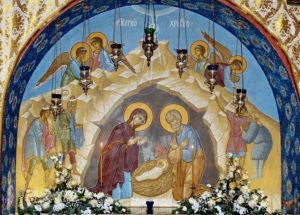
Christmas is a time for confession of faith; the Newborn Child in the manger is the Son of God who chose the humble cave of Bethlehem to show ordinary people that God’s humility is the greatest proof of His love for us.
To all, a blessed and holy Christmas! Peace and joy to every person of goodwill who opens its heart to the living God.
Paris, December 25, 2025/January 7, 2026
† Metropolitan Jean of Dubna,
Archbishop of the Orthodox Churches of the Russian Tradition
in Western Europe