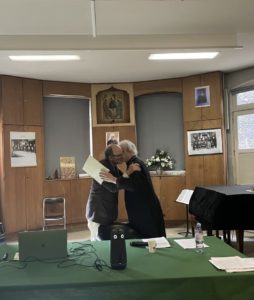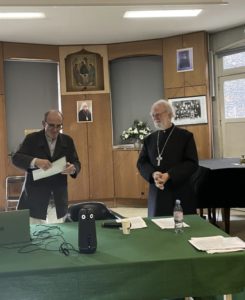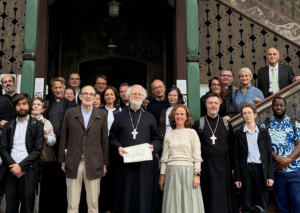
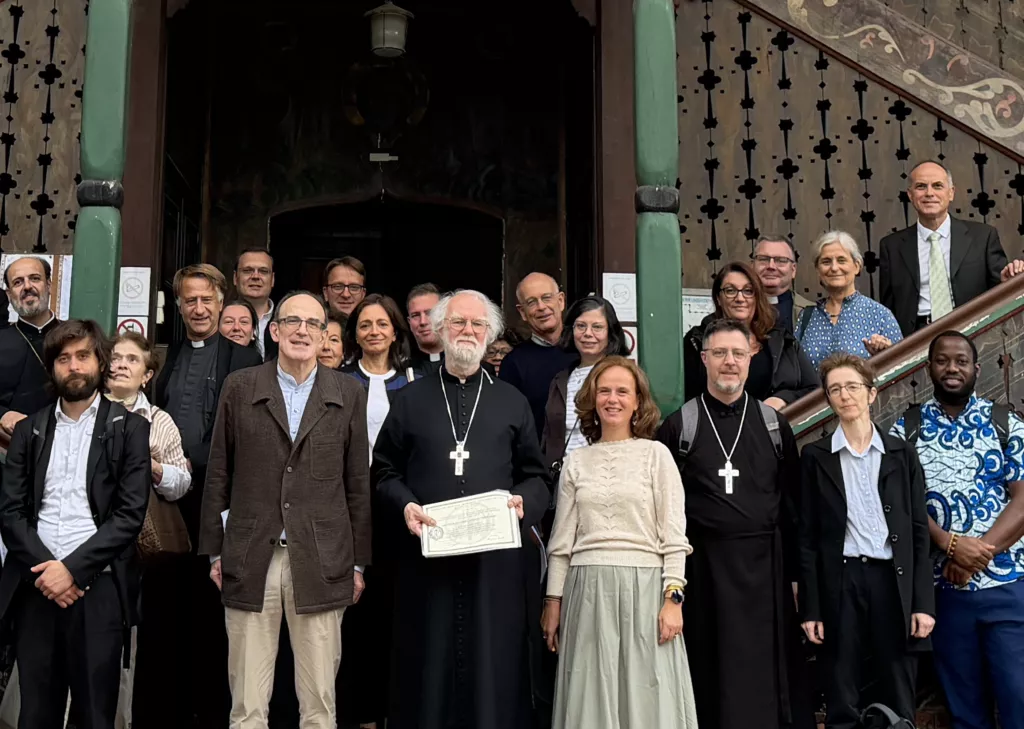
On Saturday 3 October 2026, at its formal ceremony marking the start of the academic year, the St Sergius Orthodox Theological Institute conferred the degree of Doctor of Theology honoris causa on Archbishop Rowan Williams, former Archbishop of Canterbury. More than 70 people attended the ceremony, which recognised an exceptional theological career and a steadfast commitment to dialogue between the Christian traditions.
After presenting his annual report on the 2025–2026 academic year, the Dean of the Institute, Professor Michel Stavrou, HDR, accompanied by his teaching colleagues, delivered the laudatio in honour of the new doctor honoris causa. He outlined the main features of the outstanding theological work of Archbishop Rowan Williams, an eminent figure of contemporary Christianity, former Master of Magdalene College, Cambridge (2013–2020) and former Archbishop of Canterbury (2002–2012). This work stands out for its theological and spiritual richness and for its engagement with the ethical challenges of today’s world. The Dean emphasised the deep ties that Archbishop Williams has formed and nurtured with the Orthodox Church over half a century, as well as his unwavering commitment to Christian unity.
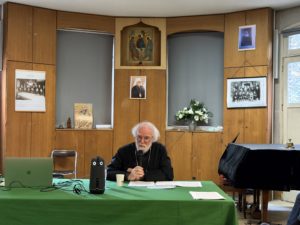
Archbishop Rowan Williams said he was deeply moved and warmly thanked the Institute for this high distinction before delivering a richly argued academic address entitled “Vladimir Lossky on the Roads of France: National Identity and Spiritual Integrity in a Pilgrim Theologian”.
In his analysis of Vladimir Lossky’s journal, Sept jours sur les routes de France (Seven Days on the Roads of France), Rowan Williams showed how the ordeal of France’s national defeat in June 1940 led the Orthodox theologian to reflect on the relationship between national identity, human freedom and divine power, warning against any sacralisation of war and nationalism. Lossky develops an understanding of catholicity founded on communion in diversity, in which local traditions are renewed by welcoming the other – the opposite both of abstract uniformity and of exclusivist identity ideologies. This political reflection sheds light on his theological vision of the Church: God’s lordship is never to be confused with earthly powers, and no nation or culture, even a Christian one, can claim to be indispensable to the work of God.
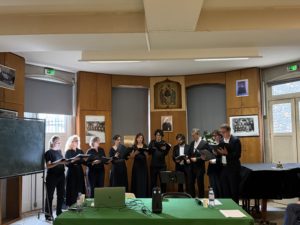
The ceremony was enhanced by the beauty of the chant of the Russian Orthodox tradition, sung in French and Slavonic by the Friends of ACER-MJO choir, conducted by Cyrille Sollogoub. The occasion continued with a buffet in the garden on the Hill, giving those present a welcome opportunity to meet and talk.
Archbishop Rowan Williams’s academic address will shortly be published in the Institute’s new journal, the Cahiers de Saint-Serge. He is the 47th person in the Institute’s history to receive this distinction.